Notes from the Kannauj Workshop
The Sixteen-Hour Fire: Why We Still Distill Rose Attar the Way Hari Bhai Did in 1920

In 1920, in a narrow lane of Kannauj, my great-grandfather Hari Bhai lit a wood fire under his first copper deg and watched rose petals dissolve into steam. He was not attempting to build a brand or make commercial announcements; he was simply practicing a four-century-old Kannauj craft with patience and honesty. Four generations later—through my grandfather Rakesh in the 1960s, my father Neeraj in the 2000s, and today in my hands—that same fire continues to burn in the exact same workshop. I know the distinct scent of our workshop at 4:00 AM when Damask roses have been distilling through the night.
In an age where industrial machinery and synthetic ingredients dominate fragrance shelves, we continue to practice the traditional deg-bhapka method because true purity permits no shortcuts.
The Sunrise Harvest
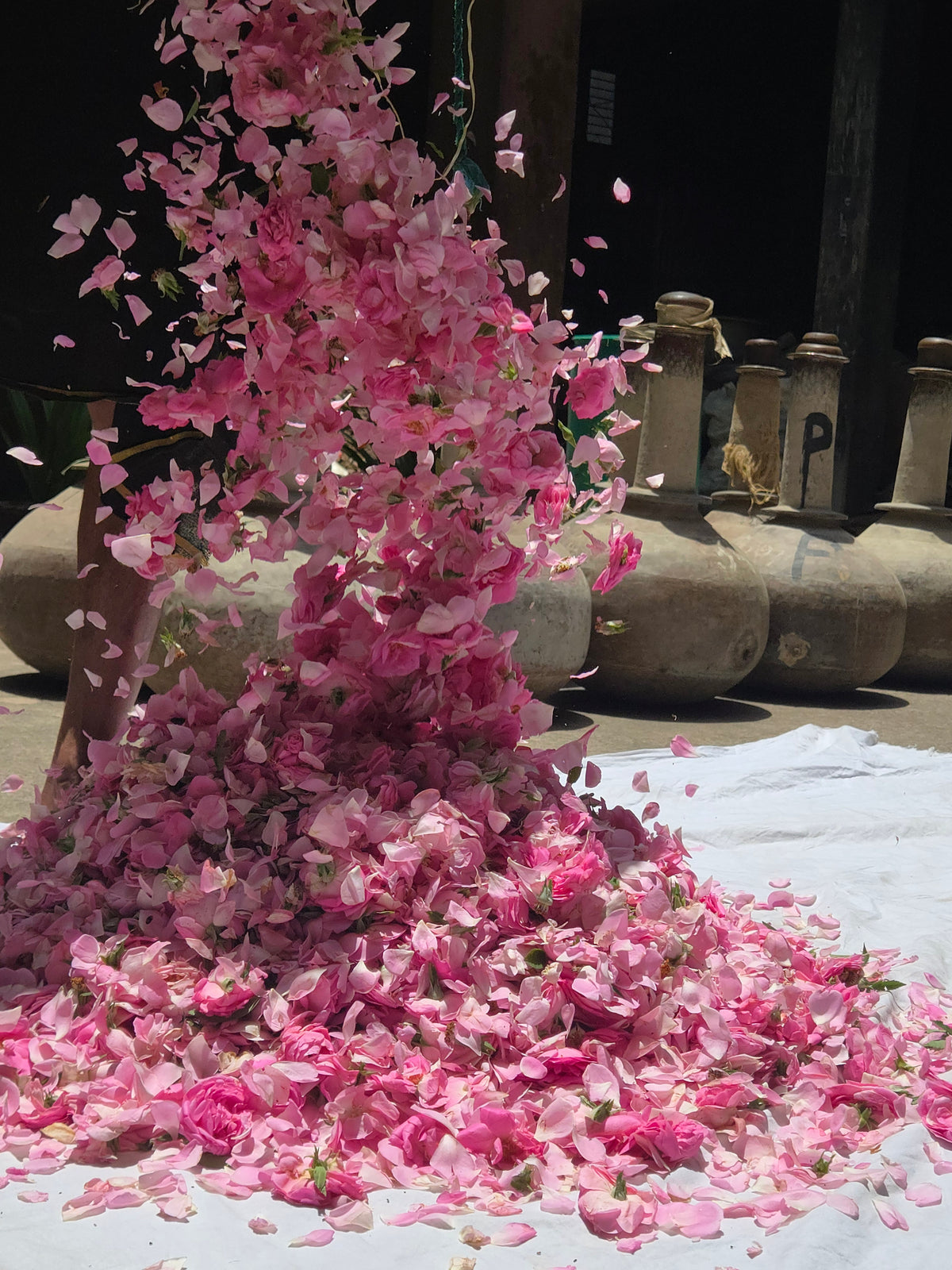
Every batch of our Gulab Attar begins during the early harvest months when Damask rose blooms reach their peak in our Kannauj fields. Before the morning heat can fully open the petals and release their essential oils into the air, the flowers are picked by hand, one by one. Timing is everything: a rose that opens fully under the midday sun has already surrendered part of its delicate aroma. The fresh petals are gathered immediately and brought to the workshop so distillation can begin without delay.
The Copper Deg and the Mitti Seal
The freshly picked petals are loaded directly into a round-bottomed copper vessel called a deg, which holds between 40 and 160 kilograms of plant material. Water is added, and the rim of the vessel is sealed with a thick ring of mitti—the native red clay from the Kannauj soil. Pressed firmly by hand, this clay creates an airtight seal that prevents steam or aroma from escaping during the hours ahead.
Tending the Wood Fire
Beneath the sealed copper vessel, a wood fire is lit. We do not use gas burners or electric heating elements. Wood provides a slow, controllable heat that must be monitored constantly. If the fire burns too hot, the delicate floral scent scorches; if it grows too cool, the steam fails to rise. Tending the flame is an unwritten skill passed down through generations by hand, requiring the artisan to read the steam and adjust the wood by instinct.
The Bamboo Chonga and Sandalwood Receiver
As the water heats, fragrant steam rises out of the vessel and enters the chonga—a hollow bamboo pipe sealed with clay at both ends. Bamboo is essential because, unlike metal, it does not conduct heat, allowing the steam to cool gently as it travels toward the receiver. The steam then flows into the bhapka, a smaller copper vessel submerged in cold water and filled with pure sandalwood oil. Unlike modern alcohol-based perfumes that evaporate off the skin within hours, the sandalwood oil acts as a natural fixative, absorbing and holding the flower's fragrance intimately and honestly.
Sixteen Hours of Patience
A single distillation batch requires twelve to sixteen hours of continuous watching. Extracting just one gram of pure Gulab attar requires the petals of over 10,000 Damask roses and sixteen hours in the copper vessel. There is no dial to turn, no machine setting to adjust, and no way to accelerate the process without ruining the quality. The artisan who lights the fire in the morning remains at the workshop until the receiver is opened.
The Unsealing and Separation
When the distillation is complete, the receiver is opened by hand. The precious attar is carefully separated from any condensed water using a traditional leather pouch called a kuppi. What remains is pure attar—concentrated Damask rose held in a sandalwood base, completely free from alcohol, chemical preservatives, or synthetic additives.
For three generations, our family supplied these pure oils to wholesalers and regional perfume houses without placing our name on the label. Today—for the first time in a hundred years—we bring this unbroken craft directly from our workshop hands to yours.
Experience the Sixteen-Hour Distillation
New to traditional Kannauj attars? Explore our Trial Pack to experience the 16-hour distillation in your own hands.
Explore the Trial Pack