1920 · Kannauj
Hari Bhai · The Foundation
Built the family reputation quietly in Kannauj, supplying pure hydro-distilled attars to regional traders.
He was willing to take the business farther. He was not willing to change what was inside the bottle.
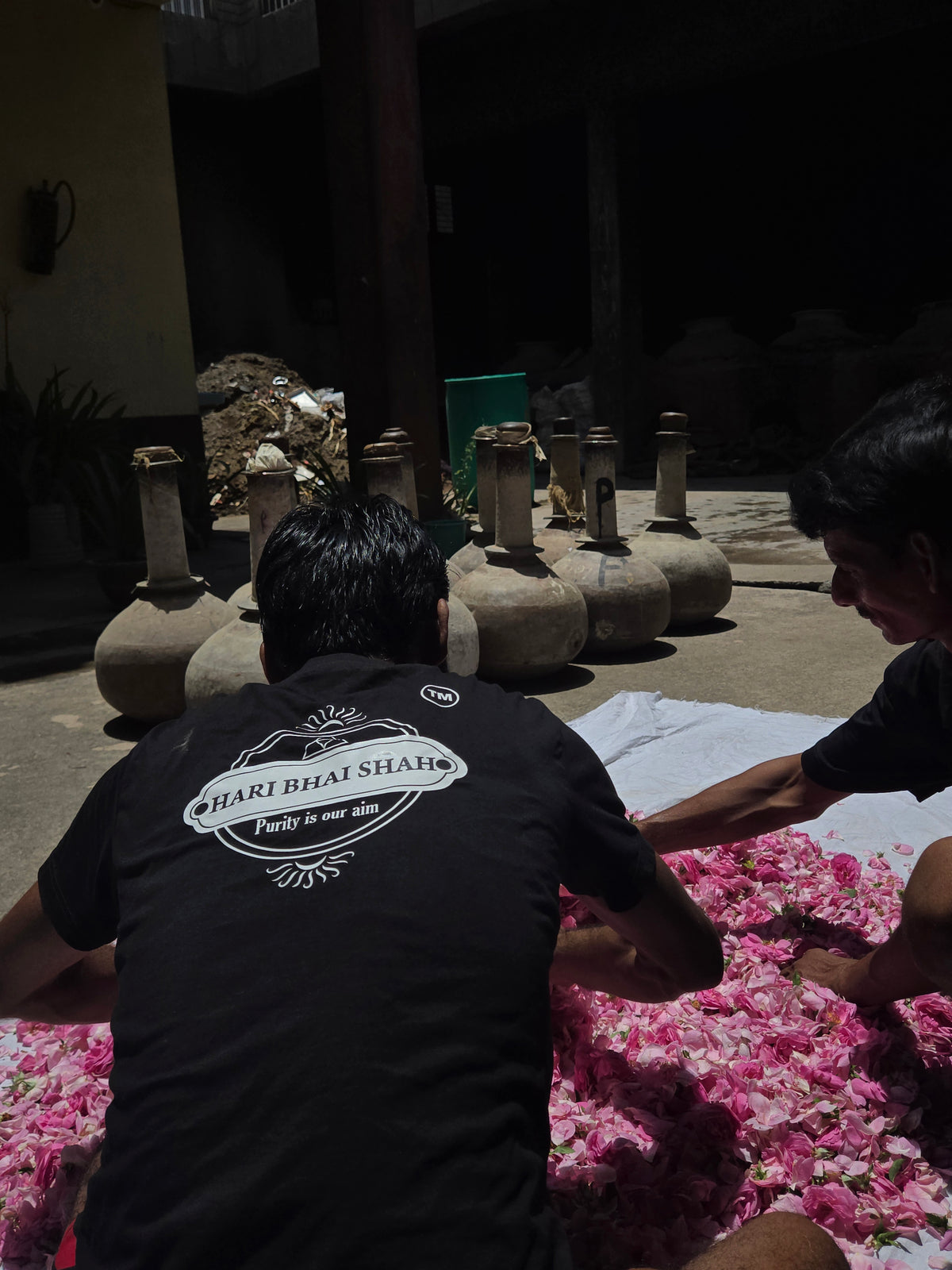
The 1960s were a different India. Industry was expanding, new materials were becoming available, and fragrance was beginning to move toward scale. In Kannauj, however, another kind of fragrance was still being made over a wood fire—a copper deg, a clay seal, fresh botanical material, and sandalwood oil. When Rakesh, the son of Hari Bhai, stepped into the family craft, he made a decision that would shape the family for decades: he would take the craft farther, but he would not dilute it.
Hari Bhai had built his reputation quietly in Kannauj. He supplied traders, wholesalers and businesses that carried fragrance to markets beyond the workshop. He was the maker behind the bottle rather than the name on the label.
Rakesh inherited that foundation. But his generation saw something different. The business could travel. The relationships could grow. The markets could become larger.
And so, in the 1960s, the work began moving beyond Kannauj into Maharashtra and Gujarat. New traders. New customers. New commercial relationships. A wider geography.
But there was one thing that did not travel differently: the method stayed home. The same fundamental craft that had been practiced in Kannauj continued to define what the family supplied.
Growth often brings pressure to change. Increase the speed. Reduce the cost. Simplify the process. Make the product more uniform. Replace the difficult parts with something easier.
For a traditional perfumer, the temptation is obvious. Why spend hours over a copper vessel when something faster exists? Why work with natural materials that vary with the season? Why rely on a craftsman's judgement when an industrial process can be standardised?
Rakesh chose not to make those substitutions. Our family history records that while fragrance around him was becoming increasingly industrialised, and synthetic notes and alcohol-based perfumes were entering the Indian market, he continued with the traditional standard he had inherited.
He expanded the business. He did not industrialise the craft.
Synthetic aroma materials brought new possibilities to perfumery—consistency, scalability, and access to fragrance profiles that did not depend on seasonal crops. For an industry moving towards larger-scale production, those advantages were significant.
But that was not the kind of fragrance Rakesh was trying to make. His family already had a language of its own: Rose, Jasmine, Kewda, Mitti, Sandalwood, Fire, Steam, Time.
The traditional deg-bhapka process did not begin with a formula designed in a laboratory. It began with the material itself. Fresh botanical ingredients are placed in a copper deg with water, sealed with mitti clay, and heated over a slow wood fire. The aromatic steam travels through a bamboo chonga into a bhapka containing sandalwood oil. A traditional batch takes between twelve and sixteen hours.
Traditional attar does not need alcohol as its base. In the deg-bhapka method, sandalwood oil receives the fragrance during distillation, acting as both carrier and fixative.
That distinction is central to the Hari Bhai Shah approach. The fragrance is not made first and then diluted into a modern perfume structure. The fragrance becomes part of the oil itself. This is why traditional attar sits closer to the skin, develops gradually, and avoids the quick evaporation burst of alcohol.
As Rakesh expanded into Maharashtra and Gujarat, the map changed, but the workshop did not. The customers were farther away, but the fire was still in Kannauj. Rakesh showed that traditional Kannauj craftsmanship could travel without becoming something else.
Fresh Damask roses picked by hand at sunrise. Degs sealed by hand with mitti clay. Wood fires tended by hand. Steam guided through bamboo. The process was never designed around speed—it was designed around control, observation, and patience.
Rakesh's customers returned season after season because they trusted what his products contained. The fragrance could change naturally from one season to another, but the standard remained: Nothing unnecessary was added. Nothing essential was removed.
More than half a century later, the geography has expanded again, but the fundamental process remains: fresh flowers, copper, clay, wood fire, sandalwood, time, and hands. Rakesh's generation took the craft outward; the generations after kept it intact. And now, for the first time, we are opening the workshop directly to you.
Built the family reputation quietly in Kannauj, supplying pure hydro-distilled attars to regional traders.
Expanded the business into Maharashtra and Gujarat, refusing synthetic shortcuts and keeping the wood fire in Kannauj.
Bringing the exact same 12-to-16 hour deg-bhapka process directly to customers without changing the standard.
1 comment
55